
Social Commerce Strategies Help Challenger Brands Grow
Challenger brands can use social commerce to turn early attention into stronger sales outcomes.



A $44 billion media channel deserves more than an engagement report.
The Interactive Advertising Bureau (IAB) projects U.S. creator ad spend will reach $44 billion. As creator budgets grow, marketers need to understand how that investment contributes to incremental growth.
Creators can make a product feel relevant in ways traditional advertising often struggles to match. They can demonstrate it in a real-life setting, answer a question a shopper has been wondering about, or give an unfamiliar brand credibility with an audience that already trusts them.
The harder questions come after the content works.
Can you extend that interest beyond the creator’s existing audience? Can the shopper find the product? Is it available where they want to buy it? Does the retailer experience reinforce what they just saw? Can you tell whether the investment generated sales that wouldn’t have happened otherwise?
Those questions shift the focus from how the content performed to what happened next: whether the interest creators generated turned into sales.
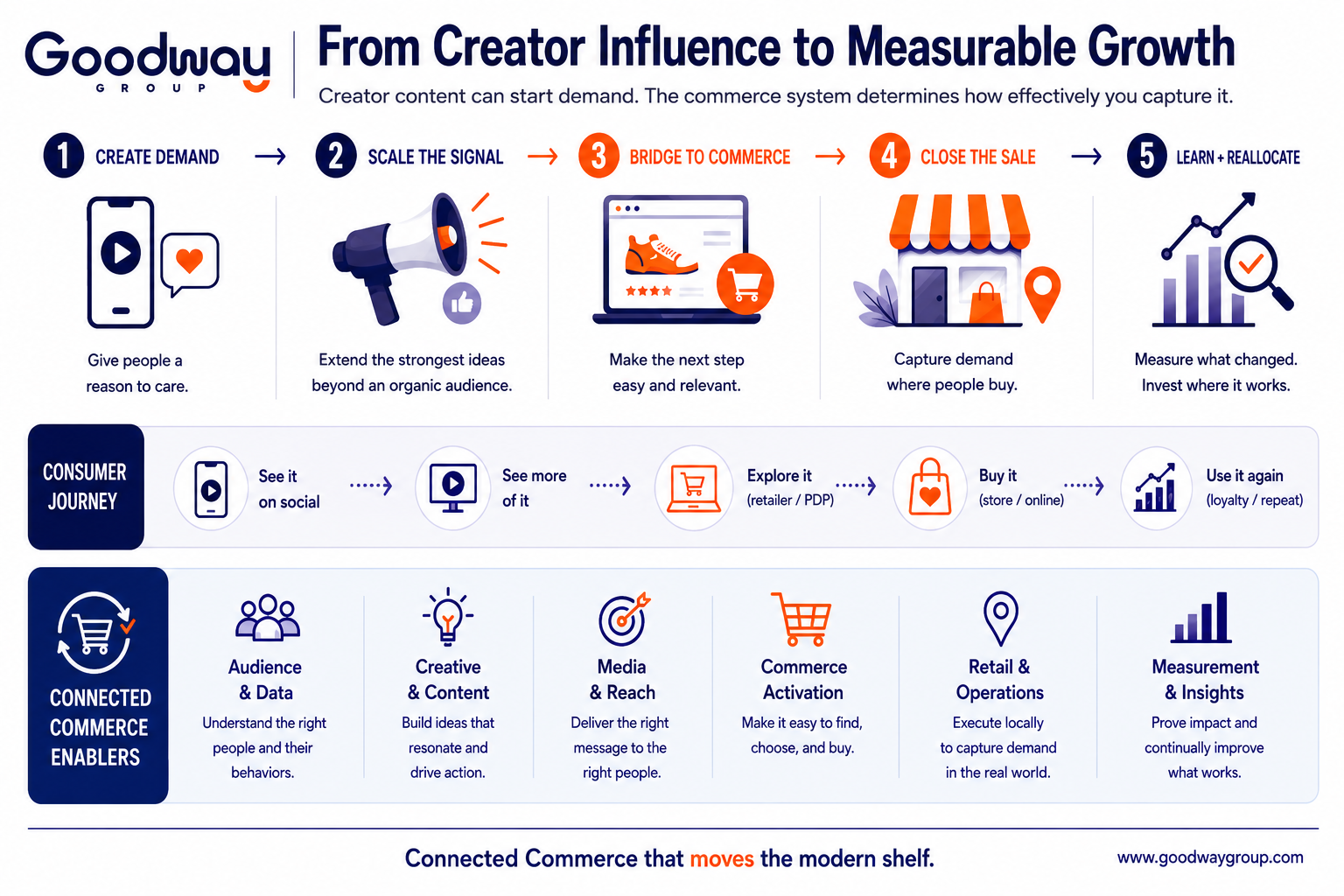
Creator marketing has grown faster than many measurement systems have evolved.
IAB’s creator measurement research points to fragmented metrics, siloed platforms, and inconsistent measurement as barriers to evaluating creator marketing alongside other major media investments.
You can see the problem in a typical campaign report.
Views tell you how many people saw the content. Engagement shows whether they responded. Affiliate sales and attributed revenue can show where conversions appeared. Those numbers help explain campaign activity, yet they leave a bigger question unanswered: How much growth did the investment create?
Marketers need to know whether creator marketing is driving incremental sales, new customers, visits, household penetration, repeat purchases, or profit. They also need to understand how it stacks up against other media investments.
That starts with deciding what a creator marketing investment is supposed to change.
For a consumer-packaged goods (CPG) brand, that may be incremental retail sales, new-to-brand households, repeat purchases, or profit. A multilocation marketer may care about incremental visits, appointments, transactions, or local revenue.
Once the outcome is clear, you can plan creator selection, paid support, commerce activation, retail readiness, and measurement against the same goal.
Follower count gives marketers a sense of scale. Creator selection also depends on audience fit, content quality, credibility, and cost.
A meta-analysis published in the Journal of the Academy of Marketing Science reviewed findings from 251 studies on influencer marketing. It found that how influencers communicate had a particularly strong relationship with purchase behavior. Creator-brand fit mattered, too, and effectiveness varied by creator, audience, post, platform, and product.
So start with what you need the creator to accomplish.
Some creators are best suited to expanding reach. Others excel at making a product benefit feel tangible and believable. Some are especially effective at turning interest into action. Others have built credibility within a community that matters to the brand.
Think about those roles in four ways:
Reach: Put the brand in front of more relevant people.
Proof: Show how the product works, fits, tastes, solves a problem, or earns a place in someone’s routine.
Conversion: Help an interested shopper take a meaningful next step.
Community: Build relevance and participation within a defined audience.
A larger creator may make sense when reach is the priority. A smaller creator may be better suited to detailed product proof, a specialized audience, or efficient conversion.
Once you know the role, audience size, cost, creative fit, content quality, and expected reach become much easier to evaluate.
A creator can make excellent content and still reach too few people to move sales at a regional or national level.
Strong organic engagement can make that limitation easy to overlook.
If creator content is expected to contribute to growth, marketers need a plan for how the best ideas will travel beyond the original post. Paid amplification, usage rights, and creative adaptability should be part of the plan from the beginning.
That means asking essential questions before signing the contract.
Can the brand put paid media behind the content? How long can the asset be used? Can it be edited into different lengths? Can it be adapted for retailer media or product pages? Are the claims cleared for broader use? Can the same idea work across social, video, commerce media, and other placements?
Those details determine how far strong creator content can travel.
They also let marketers learn more from the work. Marketers can test different creators, hooks, demonstrations, and formats. Stronger ideas can earn more distribution. Creator content can inform creative across the broader media plan instead of living inside a fixed set of posts.
That gives the brand more ways to turn a strong creative idea into enough reach to affect sales.
Imagine a creator persuades someone to try your product.
The shopper searches for it. The retailer page uses old imagery. The item they saw in the creator video is hard to recognize. Local inventory is unclear. Their preferred size is out of stock. Competitors appear first in search.
The interest was real. The sale was lost between the content and the shelf.
Creator marketing can generate demand well before a shopper reaches the shelf. What happens at retail determines whether that demand turns into a sale.
No single creator formula transfers neatly across every brand, category, and retailer. The conditions surrounding the campaign shape the result.
For CPG marketers, that means knowing where the product is distributed, whether inventory can support added demand, how it appears in retailer search, whether the product detail page (PDP) tells the same story as the creator content, and where commerce media can reinforce that story closer to purchase.
Packaging matters, too. Someone who remembers the creator content should be able to spot the product quickly online or on the shelf.
Multilocation marketers face a similar challenge.
A restaurant campaign may create demand for an offer that isn’t available everywhere. When local execution varies, so does the business result.
That’s why local availability and execution have to be part of the creator marketing plan.
Creator campaigns can produce an impressive trail of numbers: views, engagement, clicks, affiliate sales, attributed revenue, and return on ad spend (ROAS).
Those metrics show how people responded and where conversions appeared. They can’t tell you on their own how many additional sales the creator investment generated.
Incrementality gets at what changed because the investment ran.
Circana’s influencer research found that performance varied by brand size and category, with smaller and midsize brands often seeing stronger returns. Circana also reported that 75% of the brands studied had room to increase influencer investment. Using proprietary retail data and marketing mix modeling (MMM), the analysis looked at how influencer marketing contributed to sales alongside pricing, promotions, distribution, and paid media.
For some campaigns, marketers can get a clearer read by comparing similar markets, with creator marketing running in one and held out of the other. For larger investment decisions, MMM can help show how creator spending performs alongside paid social, search, retail media, promotions, and other sales drivers.
The goal is to understand how much additional growth creator marketing generated, what it cost to produce that growth, and how its performance compares with the rest of the media mix.
Marketers can then see what the creator investment is contributing. Goodway Group’s measurement approach brings incrementality testing, MMM, attribution, and scenario planning together to support better investment decisions.
Before adding more money to a creator program, decide what result would make the investment worth expanding.
For a CPG brand, that could be incremental sales, new-to-brand households, repeat purchase, or profit. For a multilocation company, it may be visits, appointments, transactions, or local revenue.
Then design the campaign around that outcome.
Make sure performance can be compared across similar audiences, markets, or locations. Lock in creator roles, content rights, inventory, retail support, and the measurement approach up front. Changing those pieces halfway through makes the final result much harder to interpret.
Execution deserves the same attention. A strong campaign can still underperform if the product is out of stock, the best assets can’t be amplified, creator audiences overlap too heavily, or certain markets can’t handle the added demand.
If sales don’t move as expected, look at where performance broke down.
The creator may have been a poor fit. The content may have reached too few new people. Shoppers may have run into availability problems. Sales may have increased while the added revenue fell short of covering creator fees, paid media, promotions, and other activation costs.
Each scenario points to a different problem.
A disappointing sales result may call for a different creator mix, more media support, stronger retail execution, or a rethink of the investment itself. The test should clarify what’s working, where it’s working, and whether the result justifies the next investment.
Connected Commerce helps marketers connect creator content with media, commerce, local execution, and measurement so more of that demand can turn into business results.
With more dollars going to creator content, marketers need clearer evidence of its impact on sales, visits, or transactions, and where additional investment is justified.
Talk with Goodway Group about building a creator strategy designed to drive and prove incremental growth.


Let's talk about what's possible when strategy meets execution with precision.